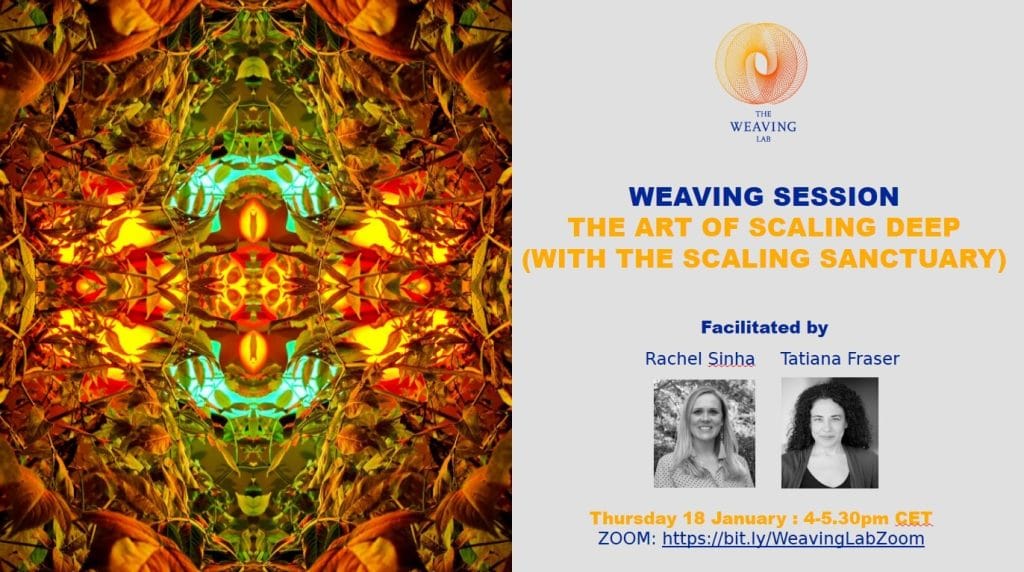
With Rachel Sinha and Tatiana Fraser 18 Jan 2024
Summary
This session looked at a transition away from traditional top-down business and academic frameworks, into the systems-change practices of “scaling deep” to impact relationships, human roots, and cultural values. This was proposed as an essential, non-linear counterpart to institutional policy shifts or project expansion. The session unpacked the constraints of metric-driven funding, western growth mindsets, and the emergence of trauma in deep community spaces. It concluded with reflections on the strategic necessity of creating a common shared language to validate intuitive, relation-based social change work.
Key Learning Points
- The Three Dimensions of Scale: Systems change relies on a triad model consisting of scaling up (policy change), scaling out (replicating innovations), and scaling deep (transforming culture).
- The Underresourced Roots: Deep culture-shifting and relational work is continuously undervalued by traditional philanthropists who push for fast numbers over foundational care.
- The Landscape Direct Connection: Deep root systems connect directly to broad socio-cultural landscapes, bypassing the linear assumption that only institutional players alter landscape narratives.
- The Illusion of Non-Linearity: Scaling deep is not merely a preliminary phase; it must coexist simultaneously with scaling out and scaling up to prevent repeating broken power dynamics.
- The Burden of Ambiguity: Organizations hesitate to fund or engage with deep inner-transformation strategies because the milestones are highly ambiguous, relational, and difficult to measure.
- Language as a Container: Developing a shared etymology and framing validates intuitive strategies and structures a movement’s boundaries.
Action Points
- Adopt the 4D Model Mapping: Expand the standard three-dimensional metrics by incorporating explicit trackers for depth, height, width, and temporal duration.
- Integrate Strength-Based Reframing: Flip traditional deficit analysis by initiating projects with a systematic survey of existing community assets and psychological strengths.
- Partner for Trauma Support: Establish formal boundaries for peer learning circles; purposefully loop in trauma-informed practitioners when projects intersect historic violence or trafficking.
- Establish Cross-Generational Spaces: Build intentional relational networks that span diverse generational cohorts to prevent historic knowledge fragmentation.
- Audit Colonial Power Models: Explicitly check expansion plans to ensure that scaling outward does not accidentally replicate hierarchical or extractive western business behaviors.
- Incorporate Multimedia Storytelling: Move away from dry, text-based institutional case studies, utilizing alternative formats like audio loops to broadcast relational change.
- De-link Metrics from Institutional Growth: Rewrite internal evaluation rubrics to separate definition of long-term success from endless metric accumulation and expansion.
 References
- Sinha, R. & Fraser, T. — The Art of Scaling Deep (The System Sanctuary research report).
- Wesley, F. & Zimmerman, B. — Systems Change and Grassroots Theory Lineage (Canadian thought leadership reference).
- Ashoka Canada — Social entrepreneurship and deep root research commission data.
- Sinha, R. — The Finance Innovation Lab Strategy Matrix (2008 post-crisis review).
- Fraser, T. — Girls Action Foundation / National Network Evaluation Blueprint.
- Geels, F. W. — Sociotechnical Socio-Cultural Landscape Transition Theory (Modified version reference).
Knowledge Base Categories: 1) Weaving Methods 2) Inner Work