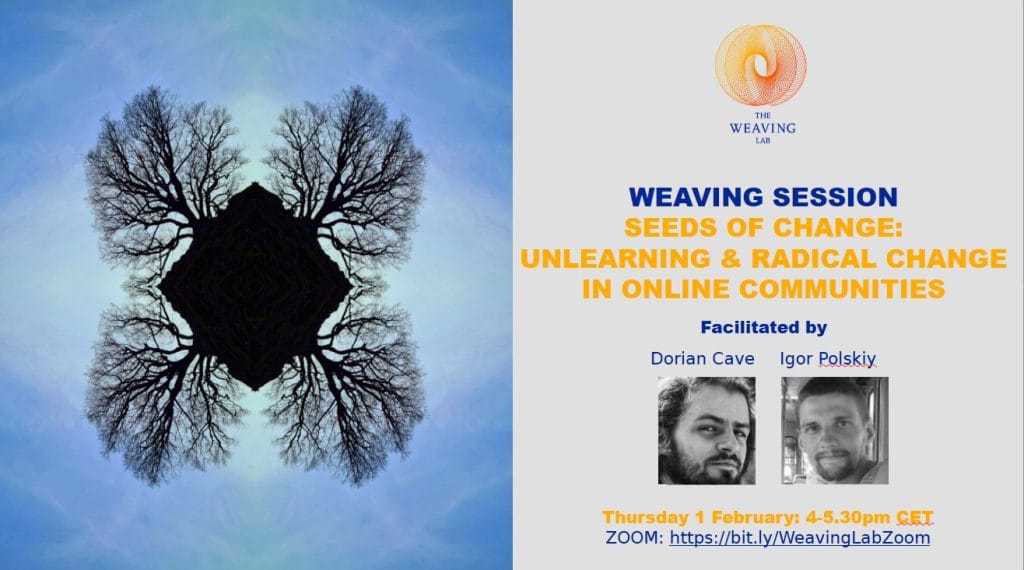
With Igor Polsky and Dorian Cave 1 Feb 2024
Summary
This session looked for “the seeds of the future” during an era of polycrisis, biodiversity loss, and systemic collapse. On behalf of the Deep Adaptation Forum (DAF), Igor and Dorian explored the move away from ‘shallow optimization paradigms’ like “green economy” or “sustainable development” and towards radical frameworks with emotional grounding in reality.
Participants were offered overviews action research into prefigurative online spaces which bypass corporate groupthink. By synthesizing decolonial theory with natural ecosystems, the hosts illustrated how mutual care, decentralized sociocratic circles, and active emotional processing can collectively compost the institutionalized denials of modern society.
Key Learning Points
- The Delusion of Shallow Sustainability: Transactional concepts like “green economy” or standard “sustainable development” frequently operate as comfortable veils that obscure real ecological limits.
- Radical vs. Conventional Hope: True resilience requires moving past false optimism into “radical hope,” which accepts existential tragedy while remaining deeply service-oriented.
- The “Bright Side” Complicity: The material comforts of modern western societies are fundamentally inseparable from global violence, systemic extraction, and hidden colonial labor.
- The Fungal Mode of Conflict: Conflict should be reframed not as an isolated problem to resolve quickly, but as a generative underground spiral that signals unacknowledged cultural currents.
- The Peril of Mutual Coddling: Online change networks stall when they prioritize polite harmony or echo chambers over open, dissenting critical discernment.
- The Trajectory of Heroic Leadership: Centralized, charismatic “heroic” leaders can spark initial momentum, but true collective maturity requires them to deliberately step down into collaborative, self-governing networks.
Action Points
- Implement the Four R’s Framework: Systematically audit your community or organization by asking questions of Resilience (what to keep), Relinquishment (what to drop), Restoration (what to remember), and Reconciliation (with whom to make peace).
- Integrate Deep Listening Circles: Regularly hold un-themed spaces where members can process stress or collapse-related emotions safely through somatic awareness and self-responsibility.
- Compost the Four Modern Denials: Design educational pathways that directly confront corporate denials of planetary limits, historical violence, structural entanglement, and problem complexity.
- Transition to Sociocratic Governance: Distribute organizational agency away from static hierarchies, adopting decentralized sociocratic circles to boost local initiative confidence.
- Audit Digital Tool Dependencies: Critically assess how online network communication tools can simultaneously connect ideas while reinforcing polarization and land exploitation.
- Enrich Social Soil: Rather than competing for scarce systemic resources, deliberately weave cross-network mutual aid cells to build a collaborative “mycelium of change”.
- Tailor Scholarly Jargon: Consciously translate dense academic frameworks into highly accessible, query-driven workshop questions that respect a local community’s culture.
References
- Bendell, J. — Deep Adaptation: A Map for Navigating Climate Tragedy (DAF core framework publication)
- Graber, D. — The Activist Scholar Model and Social Ethnography Axioms.
- Lederach, J. P. — The Journey Toward Conflict Transformation.
- Okun, T. — White Supremacy Culture Patterns and Cult-Like Institutional Manifestations.
- Gesturing Towards Decolonial Futures Collective — The Four Denials and Decolonial Educational Workshop Toolkits.
Knowledge Base Categories: 1) The Future of Weaving 2) Funding & Strategy