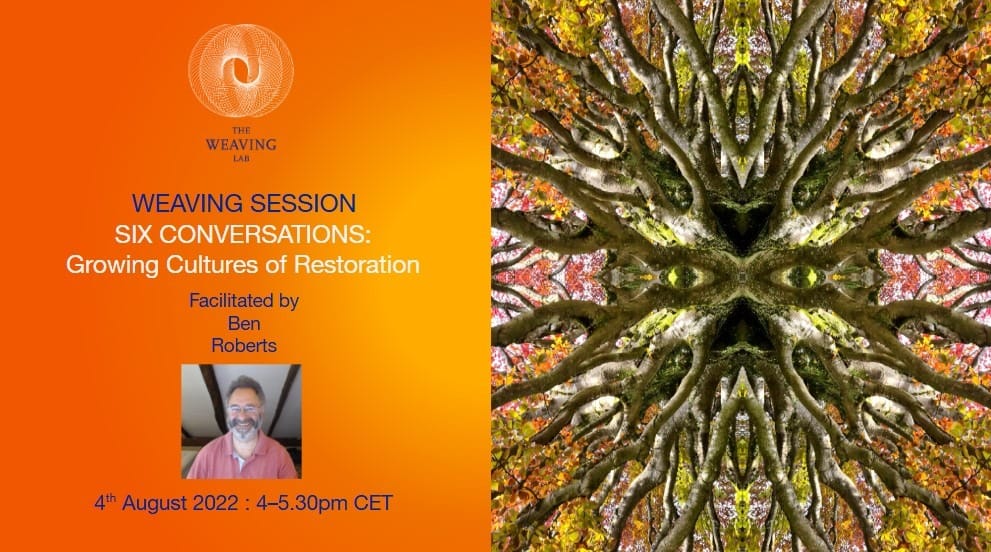
With Ben Roberts, 4 Aug 2022
Summary
This session explored the “Six Conversations” framework, a methodology designed by Peter Block to shift organizational and community culture from a paradigm of “retribution, control, and management” to one of “restoration, relatedness, and possibility.”
Key Learnings
- The Unit of Transformation: Change happens in small groups (typically 3–4 people). Large groups gather for alignment, but the deep work of shifting mindsets and building social fabric occurs in these intimate settings.
- Restoration vs. Retribution: The methodology seeks to replace the dominant culture of “fixing problems” and “blaming leaders” with a culture where citizens take ownership and focus on a future distinct from the past.
- The 6 Conversations Framework:
1. Invitation: Shifting from mandate/persuasion to free choice and commitment.
2. Possibility: Shifting from problem-solving to declaring a desired future.
3. Ownership: Shifting from blame to acknowledging one’s own role in the current state.
4. Dissent: Honoring “no” to make a “yes” authentic.
5. Commitment: Shifting from barter/lip service to making true promises without expectation of exchange.
6. Gifts: Shifting from focusing on deficiencies to acknowledging and utilizing the inherent gifts of every member.
- The Power of Declaration: A declaration is not a goal or a prediction; it is a speech act that creates a new reality simply by being stated and lived into.
- APE Questions: Powerful questions in this framework are often:
– A mbiguous,
– P ersonal, and
– E voke anxiety.
This “edge” is where real transformation occurs.
Key Actions
- Practice “Connecting Before Content”: Before diving into work, use music, poetry, or a personal question (e.g., “What is the price others paid for you to be here?”) to ground the group in relatedness.
- Create Advice-Free Zones: When in small group dialogue, practice listening without trying to “help” or “fix” the other person. This honors their ownership and power.
- Use Precise Questions: Formulate questions carefully to avoid leading people toward “safe” answers. The power of the method lies in the struggle to answer difficult, personal questions.
- Acknowledge Specific Gifts: At the end of every gathering, have members explicitly name a specific gift they received from someone else in their group.
- Invite, Don’t Command: Ensure that participation in change initiatives is a result of a genuine invitation where “no” is an acceptable answer.
—–
References
People
Paulo Freire: Referenced regarding advice-giving as a form of oppression.
Elinor Ostrom: Mentioned in the context of governing the commons.
Reading
Peter Block: Community: The Structure of Belonging (The core text for this methodology).
Peter Block: The Answer to How is Yes
Concepts & Frameworks:
The 5Cs of Impact Networks: (Referenced as a complementary framework).
Social System Mapping: Technology used to visualize the relationships and “synaptic” connections built during these sessions.
Poetry:
Joanna Macy: “Part of a Living Web” (Opening poem).
Knowledge Base Categories: 1) Weaving Methods 2) Decolonisation, Equity & Inclusion