A Weaving Lab learning session with Marilyn Hamilton 30th July 2020
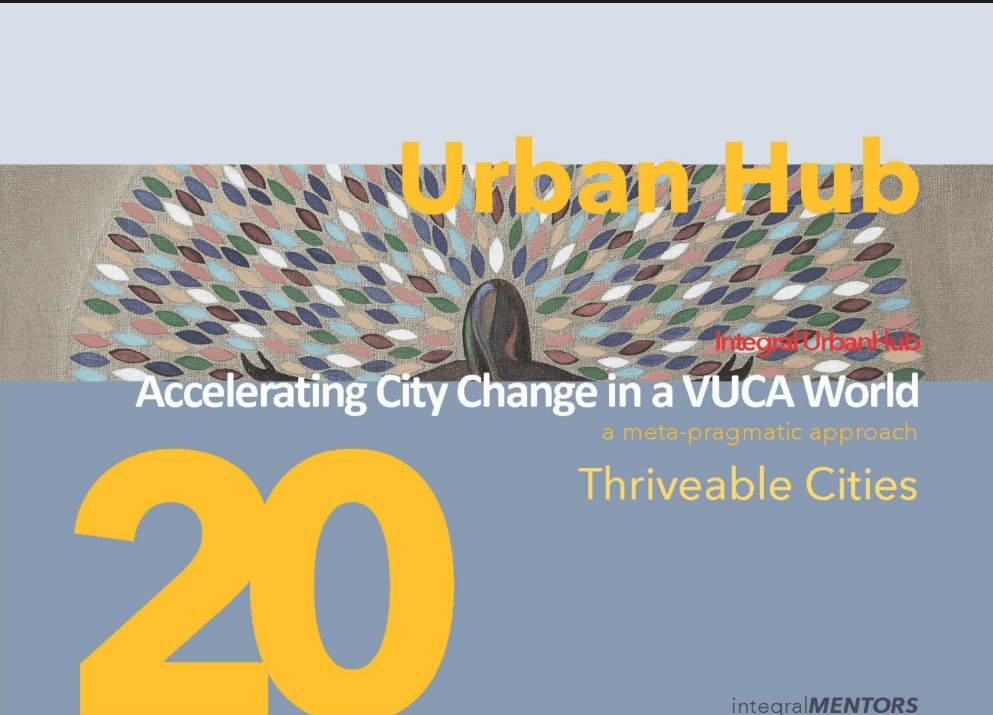
In this session Marilyn Hamilton presented ways of accelerating city change by weaving living systems through the frameworks of the Master Code of Care and Meshworking Intelligence.
Drawing on her work looking into human systems at the city scale, action research, and designing impact for “human hives” (cities viewed through a biomimicry lens), Marilyn talked of ways to handle city transformation in a VUCA (volatile, uncertain, complex, and ambiguous) world.
Key Learning Points
The Master Code of Care
The Master Code of Care is a universal principle for planetary care. It outlines a scaled, sequential approach to wellbeing:
- First, we must care for ourselves.
- Then, we can care for others.
- Together, we care for our places.
- Altogether, this adds up to caring for the planet.
Meshworking Intelligence and the Sacred Meshwork
Meshworking Intelligence is needed by weavers to manage time, while the Master Code of Care links to the “evolutionary intelligence” that drives all others. When integrally informed practices from around the world are combined to serve a city, they form a Sacred Meshwork.
The capacity development for meshworking uses a design equation to frame collaboration:
How do we work together in service to the well-being of Gaia?
with what groups of people?
for what purpose?
Where?
Elements of the Meshwork Design
Meshworking is about unpacking its design elements, which Marilyn described using examples from her work:
- The Team and Capacity
The team of practitioners, catalysts, or mesh workers must develop capacities for caring, contexting, and capacity building. The goal is to meet people where they are at (no matter their capacity level) and consider all city elements — individuals, leaders, organizations, and communities — as part of the team. - The Four Voices of the City
Effective meshworking requires identifying and engaging with the four voices of the city: - Citizens
- Civic managers
- Business innovators
- Civil society (the third sector).
- The Superordinate Goal
A complex project requires a superordinate goal to which all organizations can contribute, cohering their energy fields, and which allows the project to evolve over time. - Collaboration Over Competition
Organizations must strive to let go of competitiveness and move toward cooperative and collaborative ways of interacting. - Three Spheres of Interaction
Meshwork strategies must account for all three spheres: the Practical (technology), the Political (policy), and the large sphere of Personal Intellect Interaction. - The Power of Storytelling
In complex systems, telling stories is powerful and important for aligning values, seeing intelligences “alive,” and capturing visions. This can be guided by the idea to “think cosmically, feel globally and act locally”.
This framework was applied successfully to the Marvila project in Lisbon, which aimed to create a place everyone could call home.
Action Points
We asked AI to suggest ways of applying the Integral City framework to a local challenge based on Marilyn’s presentation. Here’s what it offered:
- Select a Focus City and Challenge: Choose a city you live in or are interested in, and identify a challenge (e.g., related to the coronavirus or another complex local issue).
- Form Your Team and Identify Capacities: As a group, consider yourselves the core team. Identify your collective capacities and how you can align your services to form a sacred meshwork to address the challenge.
- Map the Missing Voices: Determine who else should be invited to work with you in the city (e.g., specific citizens, civic managers, business innovators, or third-sector groups) to complete the four voices of the city and follow the energy.
- Define the Superordinate Goal: Articulate the overarching, high-level goal of your project that can unite all stakeholders and rise above competitive interests.
- Develop a Story Strategy: Plan how you will use storytelling to share how values align, make intelligences visible, and capture a unifying vision across the three spheres (Practical, Political, Personal).
Knowledge Hub Categories: 1) Regeneration & Universal Wellbeing, 2) Funding & Strategy