With Anne-Marie Swann and Dave Pendle on July 3, 2025
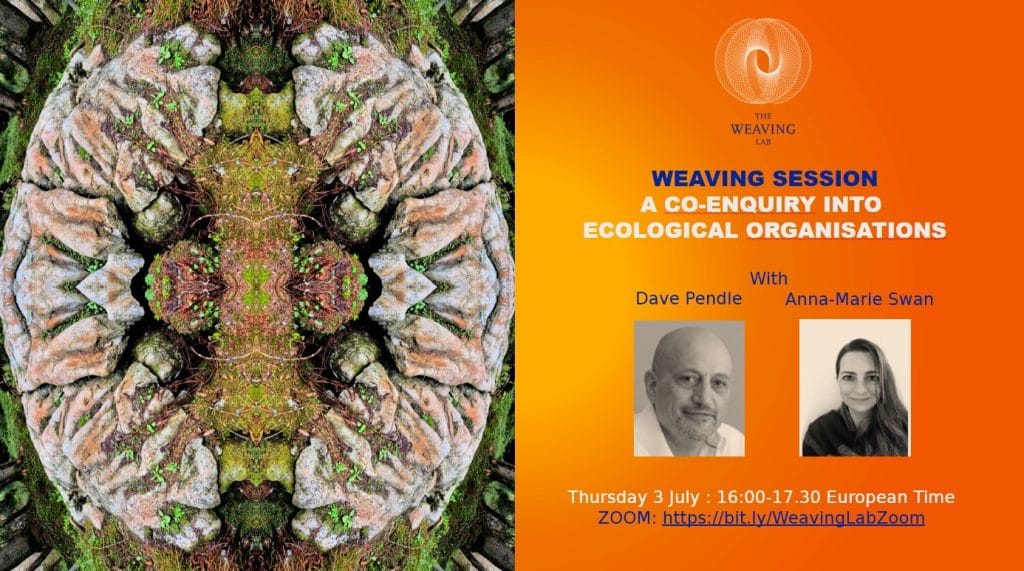
Anne-Marie Swann (Devon, England) is the author of Ecological Organizations, a Design Lens and founder of Ecological Inquiry. She also writes on Substack about being ecological and working with groups exploring their ecological nature.
Dave Pendle is Founder of Generative You and originator of Phenomenal Conversations. His mission is to co-create regenerative cultures that inspire fulfillment, impact, and wholehearted engagement with 21st-century challenges.
This session was a co-inquiry to “live into” an ecology of dialogue about ecological organizations with people who may represent their own organizations, be collaborators, or sit at the intersection of many ecosystems. The main aim of the session was to prompt good breakout discussions.
Here’s how Dave and Anne-Marie prefaced the co-inquiry:
Core Ideas
- Inquiry as a Lived Experience: Inquiry is described as an ongoing, often slow, and embodied process, not just an intellectual one. It requires conscious slowing down to become present to the whole of one’s experience (body, mind, ancestors, cosmos).
- Intentionality vs. Attunement:
- Anne-Marie distinguished between intentional attention/attunement (how we place our attention) and intention (an outward achievement or goal).
- She finds the focus on purpose challenging, noting that elements of nature (trees, animals) are often “purposeless but very very attuned and responsive”.
- Dave liked attunement as a way of inquiring by paying attention to what resonates most (deeper truth, beauty, goodness, connection, wholeness).
- Ecological Inquiry:
- Moves beyond self-awareness to self in relationship to others (a shift from “self-focused” to “self in relationship too”).
- Is a “metaphysical exploration of the universe but from an embodied experience,“tracing material reality and making space for the imaginal, sensory, and emotive”.
- It’s impossible to separate oneself from other aspects of aliveness; the inquiry becomes an “ecological exploration” of how the universe exists.
The Ecological Organizations Lens
- Questions, Not Answers: Anne-Marie’s lens arose as a set of questions for organizations, which felt right because it moved away from the idea of “answers that we can get to”.
- Two Realities: The lens points to two things simultaneously:
- Organizations are inherently ecological.
- Organizations often fail to be ecologically attuned and responsive because systems don’t encourage it.
- A Lens for Discovery: It is called a lens (not a framework or model) because it is meant to spark interest for organizations to discover and language their own ecologies.
Based on the introduction only, here some key learning and action points
Key Learning Points
- Inquiry as an Embodied Process: Inquiry is not merely an intellectual exercise but a lived, sensory, and often slow experience that requires “conscious slowing down” to become present to one’s body, mind, and environment.
- Attunement over Purpose: While traditional organizational models focus on “purpose” or outward goals, an ecological approach emphasizes “attunement” and responsiveness, drawing parallels to how elements of nature (like trees or animals) operate.
- The Relational Self: Ecological inquiry shifts the focus from “self-awareness” to “self-in-relationship,” recognizing that it is impossible to separate an individual or organization from the broader “aliveness” of the universe.
- Organizations as Living Systems: Organizations are inherently ecological, but they often fail to be attuned to this reality because current social and professional systems do not encourage ecological responsiveness.
- The “Lens” Approach: Rather than using a rigid framework or model, viewing an organization through an “ecological lens” allows for a discovery-based process where the organization can find and define its own unique language and ecology.
Action Points
- Practice Conscious Slowing: Incorporate practices that allow for attunement to the “whole of one’s experience,” including material, sensory, and emotive realities, rather than focusing solely on intellectual output.
- Shift from Answers to Questions: Adopt Anne-Marie Swann’s approach of using inquiry to “move away from the idea of answers,” using questions to spark discovery within the organization.
- Embrace Seasonality and Cyclicity: Look for ways to move with “seasonality,” recognizing the impact of weather, cycles, and “Chyros time” (opportune moments) on organizational work.
- Foster Ecosystem Responsibility: Evaluate how the organization can better center relationality and take responsibility for both its social system and its broader ecosystem.
- Engage in Deep Listening: Prioritize “deep listening” and reflections on “becoming” or “returning” to an ecological state as a core part of organizational development.
For a more personal reflection on the session, see Dave Pendle’s article ‘Weaving Threads of co-inquiry into organisations as ecologies’ here.
Knowledge Bank Cateagories: 1) Weaving Methods, 2) Regeneration & Universal Wellbeing