With Valentina Raman and Maximo Plo Seco 4 March 2021
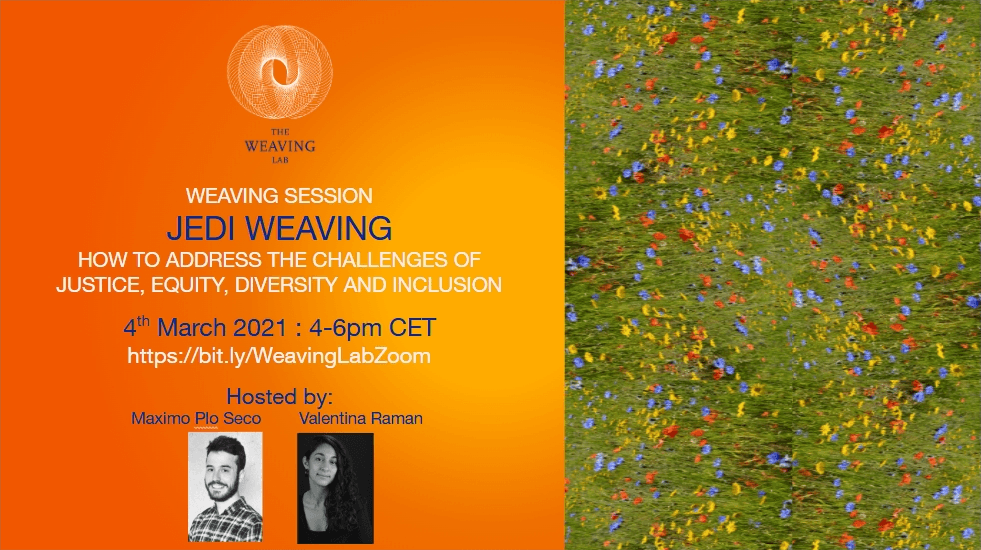
This session explores Justice, Diversity, Equity, and Inclusion (JEDI) within the context of weaving learning ecosystems. introduce tools for self-examination and unpacking social identities.
Core Learning Points
- The JEDI Vision: Justice is the ultimate systemic vision. Equity acts as the rebalancing process. Diversity and inclusion serve as essential ingredients.
- The Iceberg Framework: Hidden systemic causes drive visible discrimination. Unconscious affinity and confirmation biases deeply impact daily interactions.
- Intersectionality: Overlapping social identities create unique systems of privilege and discrimination. Ignoring these intersections makes systemic barriers invisible.
- Social Identity Wheel: Personal and societal perceptions shape individual weaving practices. Awareness of these lenses creates profound accountability in group work.
- Intent vs. Impact: Spoken intent does not guarantee a safe impact. True communication requires embracing discomfort and taking responsibility for personal triggers.
- The Mindset of Curiosity: Approaching diversity requires a deliberate willingness to be disturbed when invisible beliefs, personal biases, and core assumptions are actively challenged.
- The Cost of Identity Pain: A weaver who leaves their own unaddressed identity pain, internalized oppression, or historical trauma from colonization/domination unexamined remains inherently limited in their ability to foster transformative change in others.
Key Action Points
- Establish Co-Created Norms: Initiate every dialogue session by collaboratively building community agreements.
- Enforce Strict Confidentiality: Protect participants by making identity sharing entirely optional. Never force individuals to speak for a minority group.
- Practice Active Advice-Free Listening: Listen strictly to understand alternative viewpoints. Only offer personal advice when explicitly invited.
- Deploy Nonviolent Communication: Replace blame statements with expressions of personal impact. Pause and reflect to respond rather than react.
- Apply the Identity Wheel: Use mapping tools within teams to uncover hidden barriers.
- Speak Truth to Power: Challenge comfort levels by thoughtfully vocalizing systemic truths with love.
- Interrupt Workplace Bias: Actively track and interrupt predictable patterns of bias as they show up in operational hiring, team meetings, performance reviews, and promotions.
References
- “Willing to Be Disturbed” (Article by Margaret Wheatley): Explores navigating structural shifts with a curious mindset that welcomes worldview disruption.
- Project Implicit (Self-Assessments by Harvard University): Digital diagnostic tests evaluating implicit associations regarding race, age, gender, and sexuality .
- “How Do We Overcome Our Biases? Walk Boldly Toward Them” (Video & Training by Verna Myers): Anecdotal, practical strategies designed to bridge the gap between institutional “well-meaning” and “well-doing” .
- “How the Best Bosses Interrupt Biases on their Teams” (Article by Joan Williams & Sky Mihaylo): Practical guidelines showing how subtle bias manifests in professional ecosystems, offering diagnostic intervention strategies .
- The Racial Healing Handbook (Workbook by Anneliese Singh): A psychologist-driven reflective workbook targeted at identifying internalized racial narratives, processing trauma, and charting collective liberation .
- “Get comfortable with being uncomfortable” (Video by Luvvie Ajayi Jones): Strategic parameters for truth-telling, exploring accountability metrics when occupying dominant or powerful spaces in a room .
- “The Urgency of Intersectionality” (Video by Kimberlé Crenshaw): Foundational thesis highlighting why intersecting social dimensions are required parameters for functional justice work .
- “What Self is the Instrument?” (Article by Rebecca): Analytical breakdown of developmental human shifts, detailing how internal exploration directly unlocks structural system awareness for change makers .
- Wendy Wendia: Poetic reflection on education and personal identity.
Knowledge Base Categories: 1) Decolonisation, Equity & Inclusion 2) Weaving Methods