With Luis Camargo, 1 April 2021
Summary
This Session looked at “Seva Weaving”—a decolonized facilitation practice rooted in the Sanskrit concept of selfless service to life. Luis Camargo mapped how weavers can actively re-establish harmony across Otto Scharmer’s core systemic divides (ecological, social, and spiritual) by realigning human networks with the natural world. Using interactive software, silent visualization, and structured group harvesting, participants learned how exposing hidden barriers like fear, speed, and un-metabolized pain allows fragmented stakeholder populations to establish a shared, eco-centric destiny.
Key Learning Points
- The Reality of Life Systems: Living networks function as an organic matrix of energetic flows and relationships; the planet behaves as one massive, distributed macro-individual supported by underground fungal webs.
- The Root of Global Crises: Modern institutional crises are not analytical failures; they are symptoms of deep, chronic, and dysfunctional relationships across the ecosystem.
- Scharmer’s Three Iceberg Divides: Deep planetary suffering stems from three distinct structural ruptures:
- The Ecological Divide: The deep disconnection between self and nature.
- The Social Divide: The painful disruption between self and others.
- The Spiritual Divide: The foundational disconnect between the self and itself, eroding ownership and purpose.
- The Concept of Seva: Derived from ancient Sanskrit, Seva demands that community weavers approach ecosystem design not for individual gain or transactions, but as a deliberate act of selfless service to life.
- The Illusion of the Ego Pyramid: Extractive industrial growth is sustained by a toxic, egocentric hierarchy that positions humans—specifically white, wealthy males—on top of a pyramid of utilitarian exploitation.
- The Role of Pain in Isolation: When leaders systematically avoid processing physical or emotional pain, they grow numb, converting un-witnessed trauma into a permanent blocker that prevents connection.
- The Mechanics of the JEDI Method: True inclusion utilizes “identity wheels” to spark rapid, deep conversations about privileges, naming histories, and categories of race or religion without passing judgment.
- The Flaw of Mechanistic Accreditation: Conventional learning validation relies on a standardized, top-down, and highly bureaucratic institutional matrix that strips agency from the learner.
Key Action Points
- Ground the Negative Before Upholding Light: Force group shadows onto the surface by facilitating a methodical three-stage “mind dump” to map exactly what disconnects participants from self, others, and nature before asking what connects them.
- Leverage Nature as a Neutral Landing Ground: Bridge hostile socio-economic polarization (such as pitting wealthy private school blocks against low-income public entities) by moving dialogues into the forest to break down urban conflict anchors.
- Enforce the Three-Column Strategy Checkboard: Mandate that all organizational action plans and strategy adjustments be audited across three explicit visual categories—Self, Others, and Nature—to guarantee systemic integrity.
- Acknowledge All Relations via Mitakuye Oyasin: Introduce ancestral North American indigenous invocations at the opening of intense network design meetings to instantly anchor participants to their natural selves.
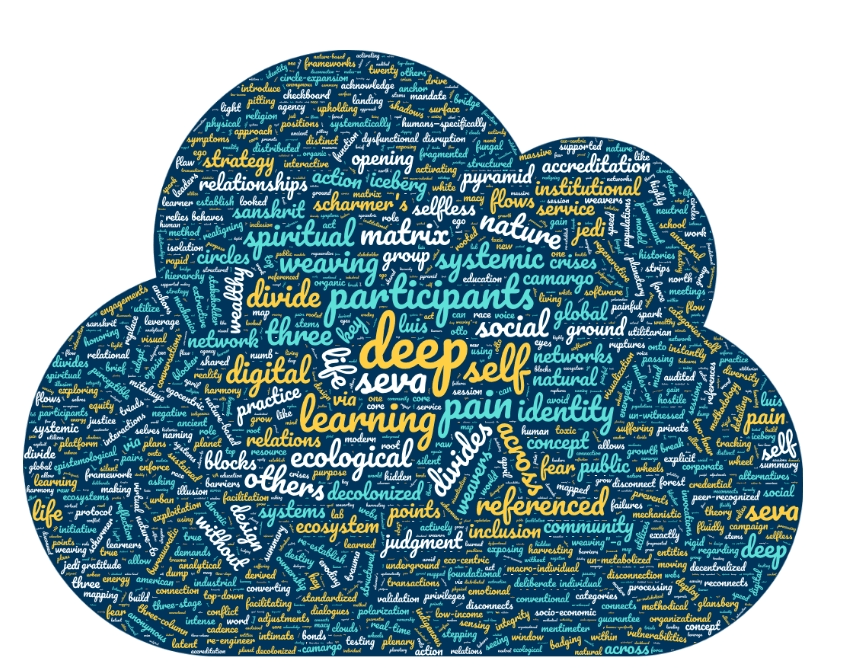
- Deploy Anonymous Mentimeter Sensing: Utilize real-time virtual word clouds during digital sessions to allow participants to voice raw vulnerabilities without fear of identity judgment.
- Adopt the Circle-Expansion Cadence: Build deep community bonds within a two-hour window by stepping interactions from intimate pairs up to triads, then to blocks of twenty, before opening to the plenary.
- Re-engineer Learning via Digital Badging Circles: Replace rigid corporate testing frameworks with decentralized, peer-recognized “credential circles” where learners enter fluidly through reflection or practice.
References
- Glansberg, J. Systemic Energy Flow Engagements (referenced framework regarding making relational flows latent and perceptible).
- Macy, J. The Work That Reconnects (referenced methodology on deep gratitude, honoring pain, and seeing with new eyes).
- Scharmer, O. The Iceberg Model and Theory U (referenced epistemological mapping tracking the ecological, social, and spiritual divides).
- The Jedi Weaving Protocol Brief. Justice, Equity, Diversity, and Inclusion in Systems Ecosystems (the public drive resource detailing the identity wheel matrix).
- The Weaving Lab Network Campaign. The What If Initiative (the global digital platform exploring decolonized learning accreditation alternatives).
Knowledge Base Categories: 1) Weaving Methods 2) Inner Work