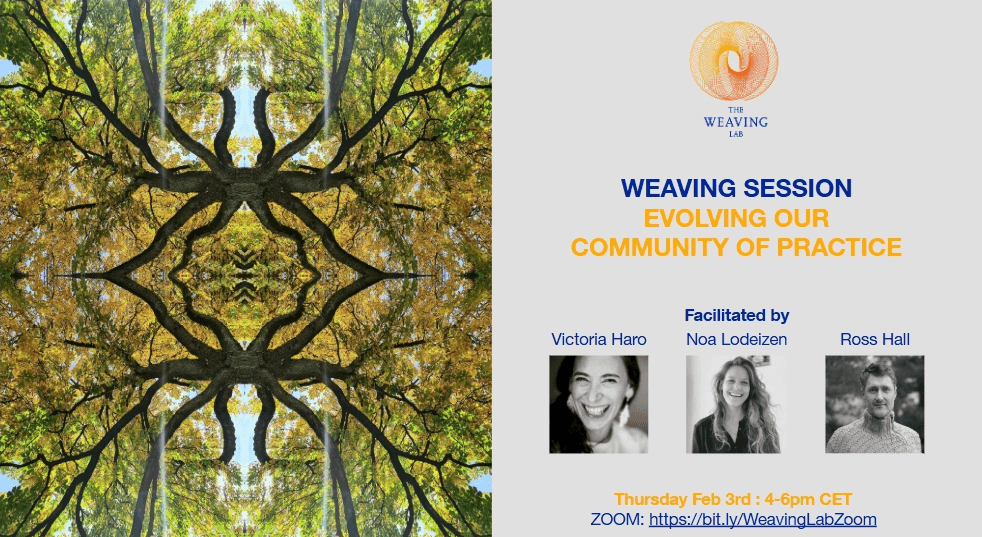
With Ross Hall, Victoria Haro & Noa Lodezein 3 Feb 2022
Summary
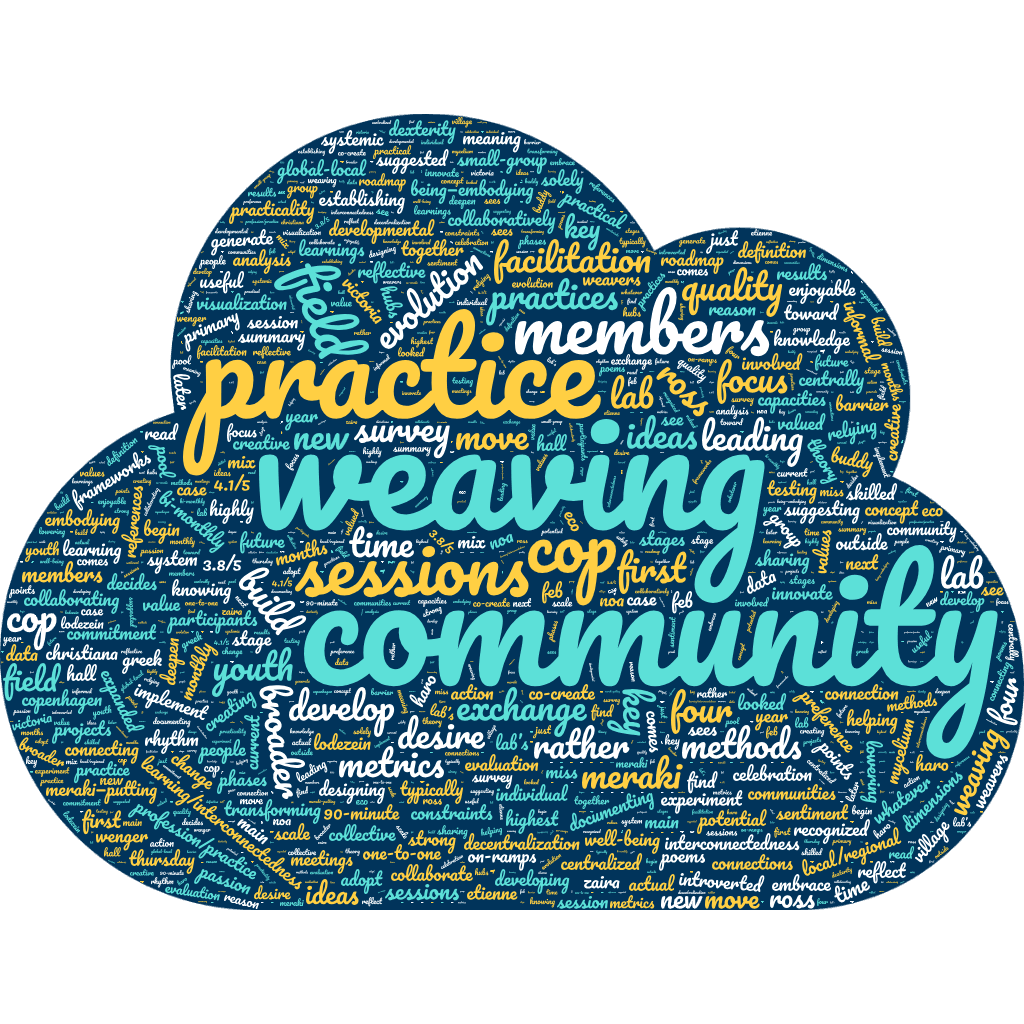
This session was a reflective evaluation of the first year of The Weaving Lab’s “Community of Practice” (CoP) which looked to co-create a roadmap for its future evolution. It involved a mix of celebration, data analysis (from a community survey), and creative visualization.
Key Learnings
Definition of a CoP: A community of practice is a group that comes together to practice, exchange ideas, and develop both their individual capacities and the field itself (in this case, “weaving”).
The Four Phases of CoP Evolution: Communities typically move through four developmental stages:
1. Exchange: Sharing ideas and practices (the current stage of the lab).
2. Experiment: Collaboratively testing and designing new practices.
3. Generate: Creating and documenting new knowledge.
4. Innovate: Transforming the broader field of practice.
Community Sentiment (Survey Results):
- Quality: The community is highly valued for its people and the quality of learning/interconnectedness
- Practicality: Participants find the sessions more “enjoyable” (4.1/5) than “useful” (3.8/5), suggesting a desire for more practical weaving methods.
- Time: Time constraints are the primary reason members miss sessions, leading to a preference for 90-minute monthly sessions rather than bi-monthly.
- Weaving: The community sees its highest potential in establishing weaving as a recognized profession/practice.
- “Being”: Weaving is not just about doing (methods) or knowing (theory), but centrally about being—embodying the values of interconnectedness and well-being.
Action Points
- Move Toward Decentralization: There is a strong collective desire to scale through local/regional hubs (global-local connection) rather than relying solely on a centralized rhythm.
- Implement a “Buddy System”: To deepen one-to-one connections, members suggested informal small-group meetings outside of the main Thursday sessions.
- Focus on Facilitation: Develop “on-ramps” for members to practice facilitation, helping to build a broader pool of skilled weavers and lowering the barrier for introverted members.
- Collaborate on Metrics: Begin leading the field in developing metrics that reflect the actual value of weaving and systemic change.
- Embrace “Meraki”: Adopt the Greek concept of Meraki—putting passion, dexterity, focus, and commitment into whatever the community decides to build next.
—–
References
Poems:
“Mycelium” (read by Ross and later expanded by Zaira).
Key Frameworks:
- Community of Practice (CoP): see Etienne Wenger.
- Weaving Dimensions: Connecting, Collaborating, Learning, and Embodying
- Meraki (meaning)
Projects:
Christiana Eco Village, Copenhagen
Youth by Youth
Knowledge Base Categories: 1) WL COP