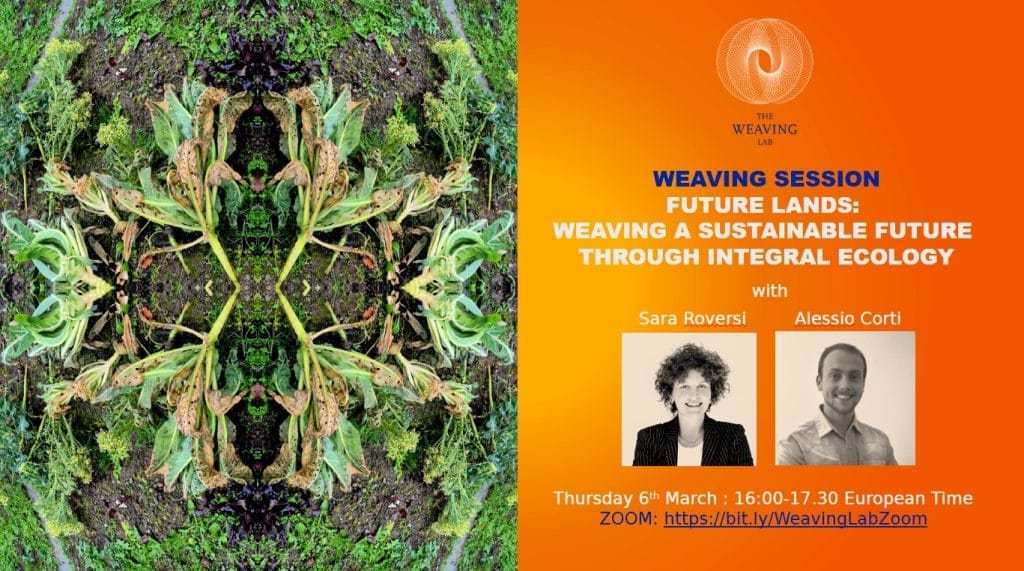
Future Lands: Weaving a Sustainable Future Through Integral Ecology
With Sarah Roversi and Alessio Corti 6 March 2025
Summary
This session focussed on the “Polica model,” a systemic framework that transforms marginal territories into living labs for sustainable innovation, rooted in the values of the Mediterranean diet, regenerative agriculture, and interconnected human-environmental health. Operating from an Italian campus established in 2020, the project manages over 90 diverse initiatives and aims to replicate this model across at least 500 global territories, with ongoing expansions in Florence and Japan.
The concept of “slow weaving,” community empowerment, and the vital role of storytelling over rigid methodologies were all discussed, concluding that frameworks must be held lightly to encourage co-creation and restore intergenerational trust.
Key Learning Points
- The Power of Territory and Place: Connecting global food and sustainability challenges to ancestral roots, hyper-local identity, and living regional heritage acts as a powerful ecosystem baseline.
- Integral Ecology and Core Balance Pillars: True sustainable transformation requires maintaining balance across six strictly interconnected areas:
i) Political vision
ii) Care for the earth
iii) Human health
iv) Societal interaction (co-creation/cooperating)
v) Cultural heritage preservation
vi) Stable economic pillar.
- The “Living Lab” Concept over Traditional Classrooms: Offices and environments should function as open living labs embedded directly inside communities. These labs foster challenge-based co-learning, engaging diverse generations, public stakeholders, and private actors.
- Systemic Ecosystem Solutions vs. Isolated Silos: Traditional incubators often look for narrow, siloed technical answers (e.g., alternative proteins or plastic fixes). To succeed long-term, initiatives must approach complex environmental issues via systemic frameworks rather than throwing isolated investments at individual issues.
- The True Mediterranean Diet Framework: Beyond nutrition, the Mediterranean diet historically acts as a complete cultural structure and way of living (“dieta”), focused heavily on regenerative agricultural practices, community time sharing, biodiversity, and soil preservation.
- The Limitations of Playbooks and Methodologies: A rigid framework or playbook is a crystallization of a single point in time. If a framework doesn’t keep a community dynamically alive and shifting with real context, it should be discarded or adapted heavily.
Key Action Points
- Abstract and Replicate via Playbooks (Not Scale Up): Rather than blindly copying or imposing top-down blueprints into a geography like “aliens,” weavers should abstract successful localized models (such as the Polica model prototype) to co-create, adapt, and reshape frameworks to suit unique local community dynamics.
- Incorporate Social Arts and Playful Formats: Utilize social arts, folklore, theater, music, and performance to engage citizens dynamically. Playful and intuitive reconnection forms make it easier for diverse age groups to attach to the land and community compared to static academic conferences.
- Hold Methodologies Lightly: Ensure structured models are held loosely to protect the overall flow and avoid shutting down the “field of possibility.” Structures should inspire reflective conversations and emergence rather than serving as rigid boundaries.
- Practice “Slow Weaving”: Avoid compressing time and fast-thinking patterns. Allow shared understanding to grow at natural intervals, embracing relational, community-driven pacing reminiscent of the “slow food” movement.
- Rebuild Deep Institutional & Generational Trust: Intentionally design spaces that breach cultural boundaries, creating explicit, long-term feedback bridges among groups historically lacking trust (e.g., youth and elders, public sectors and private startups, farmers and politicians).
- Leverage Local Storytelling / “Song Lines”: Move global collaboration forward by combining gentle environmental maps or “song lines” with powerful storytelling, as stories serve as the primary fuel for spreading systemic inspiration.
References
- Pope Francis. (2015). Laudato si’: On care for our common home (Encyclical letter framing the 6 pillars of integral ecology referenced in the session).
- UNESCO. Emblematic Communities of the Mediterranean Diet (Cultural heritage frameworks utilized to map out the foundational project).
- UN United Nations. Sustainable Development Goals (SDGs) & COP21 Paris Agreement (The macro-level metrics utilized within the global foundation tracking framework).
Knowledge Base Categories: 1) Regeneration & Universal Wellbeing, 2) Weaving Methods