Summary
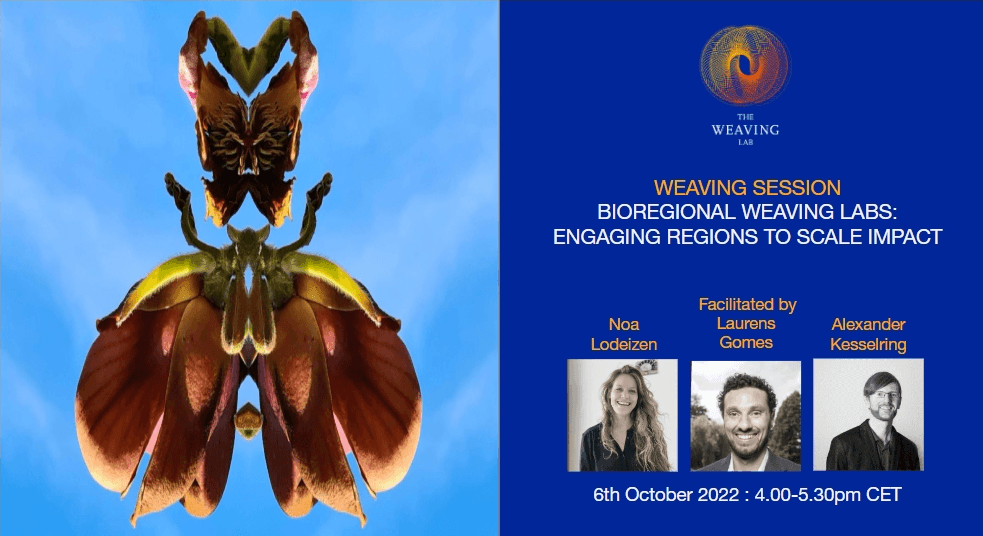
This session explored “weaving” as a decentralised strategy to scale systemic social and ecological impacts without forcing exponential organizational growth. Co-hosted by representatives from Ashoka and Commonland, the discussion looked at how the Bioregional Weaving Lab (BWL) framework connects international proven innovations with local, bottom-up regional stakeholders to drive landscape-scale regeneration.
Key Learning Points
1. The Conceptual Shift: Scaling Impact vs. Organizational Growth
- Decoupling Growth and Impact: Alexander Kesselring (Ashoka) outlined that traditional commercial scaling focuses on linear organizational growth (expanding staff, revenue, and branches). Conversely, social innovation scaling targets exponential indirect impact by empowering external partners to adopt, adapt, and run the innovations while keeping the core organization small, sustainable, and focused.
- Letting Go of Control: True systemic scaling requires innovators to cross a “tipping point” where they relinquish absolute control over their methodology, allowing communities to co-create and localise it
2. The Social Replication Spectrum
Kesselring presented a structural spectrum based on the balance between organizational control and speed of dissemination:
- High Control (Left): Branching out directly. It guarantees quality but requires heavy resource investment, lacks flexibility, and slows down growth
- Balanced Affiliation (Middle): Formal networks using social franchising, licensing, or certification (e.g., Sea Ranger Service, Havelmathen / Kampeland) (pp. 13-14, 16).
- High Dissemination (Right): Open-source sharing and organic imitation where the community holds high autonomy (e.g., Incredible Edible) (pp. 12-13, 15-16).
3. The Concept of Bioregional Weaving
- Four-Layer Weaving: Noa Lodeizen (BWL) described weaving across four interconnected tiers:
- Backbone Collaboration: Aligning the founding anchor organizations (Ashoka, Commonland, and the Presencing Institute)
- Regional Labs: Weaving multi-stakeholder coalitions inside 10 target European bioregions
- Innovation Infusion: Threading external scalable systemic innovations directly into local lab portfolios
- Inter-lab Synthesis: Weaving the distinct bioregions together to form a unified global voice
- The “Four Returns” Objective: The BWL platform acts as a magnet to activate 1 million changemakers to regenerate 1 million hectares of European land/sea, delivering significant returns across Social, Ecological, Financial, and Changemaking domains
4. Practical Realities of Grassroots Weaving
- Language and Trust-Building: Sarah, a regional weaver in Ireland, emphasized that weavers must serve as “translators”. Top-down organizational vocabulary (like “changemaker”) must be carefully aligned with the local realities and authentic passions of grassroots practitioners (e.g., farmers asserting their role as primary decision-makers)
- Power Dynamics: Weaving is inherently organic. Introducing structured institutional funding or explicit authority figures risks distorting the delicate field of localized, trust-based relationships
Key Action Points
- Transition to Systemic Strategies: Organizations looking to expand must audit where they sit on the replication spectrum and actively design models (like social franchising or localized toolkits) that maximise dissemination over institutional footprints
- Draft Local Manifestos: To bridge the gap between global frameworks and local actors, regional labs should co-author localized manifestos that capture the distinct emotional drive and cultural nuances of regional stakeholders
- Map Regional Ecosystems & Barriers: Regions must map existing local innovations, find resource synergies, and preemptively identify systemic bottlenecks (such as rigid legal frameworks or traditional agricultural chambers that oppose community-led farming formats)
- Redesign Funding Cascades: Systemic networks need to pioneer creative financing mechanisms that bridge large-scale global capital pools down to tiny, mycelial grassroots actions (metaphorised as “clouds raining water effectively onto the complex relationships of the forest floor”)
- Leverage the Circular Economy: Utilize circular economy frameworks (e.g., neighbourhood sharing, community composting initiatives) as tangible entry points to successfully unlock corporate and municipal funding lines
 References & Organizational Context
- Ashoka: Global network that supports social innovators and provides foundational frameworks for system-changing scaling models
- Bioregional Weaving Labs (BWL): A multi-organizational collective aiming to restore European landscapes by mobilizing change networks
- Commonland: An international organization deploying holistic landscape restoration strategies centered on the “4 Returns” framework
- Havelmathen / Kampeland: a systemic, community-led citizen farming model functioning as an innovation example
- Incredible Edible: A community-led open-source movement referenced to exemplify a highly disseminated scaling model with low central control
- Sea Ranger Service: A structured social franchising project referenced as an example of balanced control scaling
Knowledge Base Categories: 1) Regeneration & Universal Wellbeing 2) Weaving Methods