A session with Dr. Jan Kruse 4 December 2025
The core idea is to present a way of weaving that pays close attention to what we perceive ‘in the moment’ as a starting point of orientation.
The Philosophical Frame (Phenomenology)
- Definition: Phenomenology is described as a whole philosophy and, simply put, a theory of knowledge through perception.
- Core Tenet: It emphasizes getting in touch with reality, not just having an idea of it, summed up by Husserl’s statement: “To the things itself!”.
- Practical Beginning: The starting point is to “take the obvious” (Fritz Perls) while setting aside corresponding assumptions and judgments (epoché).
- Sense-Making: Meaning arises through the enactive focus on what the perceived object is (eidetic reduction). The Meaning is not hidden but is co-created.
- Acceptance of Reality: The philosophy encourages finding back trust in what actually is and accepting that reality is authority.
Phenomenology of Weaving and Contact
- Weaving as Co-creation: A central idea of weaving, referred to, is the way of co-creation.
- Duality and Position: Understanding creation reductionally (as one acting upon the world) leads to duality and questioning one’s place within the world
- The Gestalt Therapist’s Answer: Reality is centered on the actual contact; there is no actuality the individual is not in contact with. Contact is, by definition, a co-creation within the holistic “organism-environment-field” (the I-world-horizon).
- Perception: Perception is an intentional, enacted, relational movement, not just reception or suffering the world. The world also needs to “speak” or affect the person.
- The Here and Now: Reality is perceived as the actuality of one’s world, which is the “Here and Now” enriched by sense-making. The most important question is: “What is now?”.
Phenomenological Practice Topolography
Jan Kruse (with Beate Willauer) developed a map, or topolography (a map of relational landmarks in a multidimensional field), for phenomenological practice. This map serves as an orientation in the present contact and includes six interconnected landmarks. It is useful to understand the position someone or a group is in, when feeling stuck. All marks should be engaged with.
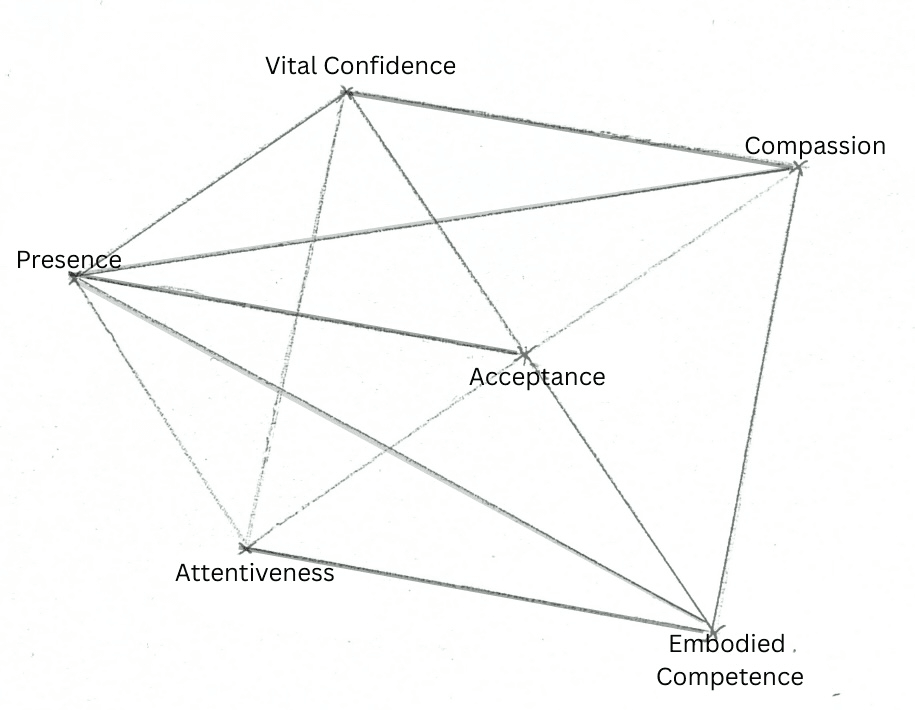
Use the map by asking which landmarks need your attention in a specific situation. ‘Where are you in the topolography now? Which landmark needs attention?’
| Landmark | Description |
| Presence | Being aware of one’s foundations, remaining responsive, breathing, and perceiving contact boundaries: “I am here.” |
| Acceptance | Unconditionally allowing whatever appears (destruction, construction, etc.) so one can choose a response, not resignation: “I stay with the trouble.” |
| Compassion | The feeling recognized when accepting what is (despair, hope): “I recognize my feelings.” |
| Embodied Competence | Knowing the next appropriate step and being competent in moving within one’s world: “I am aware of the next appropriate move.” |
| Attentiveness | Moving towards others and oneself, taking genuine interest: “I turn toward other beings and myself with interest.” |
| Vital Confidence | Knowing one will continue living, and clarity about needs/desires will emerge: “I continue; clarity will emerge.” |
Key Learning Points:
- Focus on Actuality: True reality is found in the “Here and Now” and the actual contact experienced, not in abstract ideas or assumptions.
- Perception is Action: Perception is an active, relational, and intentional process, not just passive reception
- Co-creation is Inescapable: We are not separate from the world; contact and creation are fundamentally a shared, co-created process
Key Action Points:
- Practice Epoché: In any situation, start by setting aside all assumptions and judgments (“Just look. What do you see?”).
- Ask the Core Question: Regularly ask, “What is now?” to ground yourself in the current actuality
- Use the Topolography for Orientation: Use the six landmarks (Presence, Acceptance, Compassion, Embodied Competence, Attentiveness, Vital Confidence) to identify where you are in a situation and which landmark needs your attention
For more information visit the site of Jan Kruse und Beate Willauer´s Seminar for Gestalt Therapie (D/CH) www.sfgt.ch.
Knowledge Base Categories: 1) Weaving Methods, 2) Inner Work