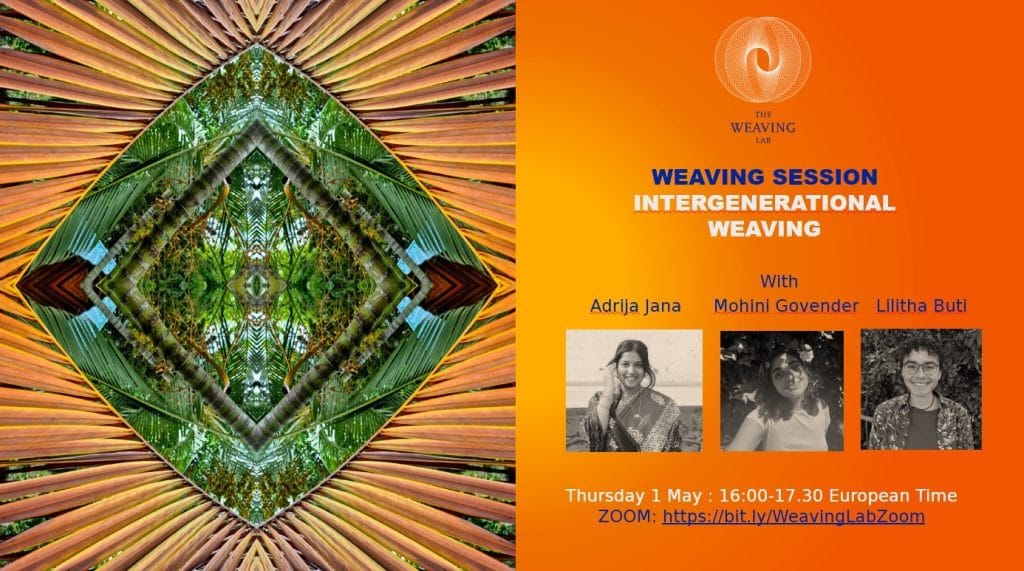
This session is part of an ‘intergenerational’ series of action-research conversations in partnership between Weaving Lab and YouthxYouth (YxY). The aim is to move from tokenistic youth representation with adult mentorship into an egalitarian dialogue between global youth activists and adult allies. Sessions focus on live testimony, silent breakout processing, and participatory harvesting. This meeting established a Version 1.0 architecture of organizational relational principles explicitly designed to heal generational trauma and break down systemic age segregation.
Key Learning Points
- The Architecture of Age Segregation: Modern systemic geographies systematically fracture human connection through spatial and institutional grouping. Retirement homes isolate elders, schools package children tightly by birth year, and standard corporate models reject the young while discarding the old.
- The Paradigm Shift to Allyship: Authentic intergenerational ecosystems replace conventional “mentorship”—which inherently implies a strict top-down knowledge hierarchy—with peer-level “allyship” centered on side-by-side co-creation.
- Unmetabolized Generational Trauma: Deep psychological barriers between age groups are fundamentally rooted in historical societal pain, collective grief, and un-witnessed trauma that has not been properly processed or metabolized by ancestral lines.
- Prefigurative Ancestor Mindsets: Youth participants frame their current structural leadership stance through a dual temporal identity: acting simultaneously as active historical descendants and future “ancestors-in-training”.
- Rigidity of the Status Quo: As individuals spend decades navigating existing systems, rigid institutional mindsets naturally set in. Youth weavers bring a necessary systemic disruption because they maintain the cognitive space to hope, question traditional norms, and lovingly challenge comfortable defaults.
- The Tokenism vs. Participation Axis: Standard international working spaces routinely tokenize young leaders by giving them visible podiums or advisory boxes while fully excluding them from core strategic design and decision-making actions.
Key Action Points
- Deploy Invisible Weaver Invocations: Ground abstract focus groups by instructing every attendee to explicitly name a specific young person or friend in the chat, holding a mental picture of their face to channel real-world accountability.
- Transition Boards into Circular Wisdom Councils: Re-engineer corporate board structures into multi-generational “Wisdom Councils” governed by a circular, rhythmic sharing pattern where no single age bracket is deemed the exclusive keeper of truth.
- Utilize Media as a Generational Connector: Launch hyper-local intergenerational storytelling interventions—such as raw documentary projects capturing the lived refugee or survival experiences of grandparents—to spark direct neighborhood-level bonding and combat isolation.
- Differentiate Representation from Meaningful Co-Design: Ensure all strategic initiatives are co-designed from inception by mandating that student and youth voices hold definitive voting power over funding distribution, internal budgets, and localized policy definitions.
- Reject Forced Consensus Rules: Cultivate resilient change networks by explicitly training participants that agreements do not require absolute consensus; holding space for safe disagreement and sitting with raw relational tension is a core requirement.
- Execute the Four Metaphorical Asterisks Test: Review collective “Dos and Don’ts” harvest charts by granting each stakeholder exactly four electronic votes (asterisks) to assign to specific principles, visually isolating the highest organizational values within the length of a single song.
References
- YouthxYouth (YxY) (referenced regarding the global community mission and the structured Weavership Program).
- The NRAA Youth City Leadership Program (the Colombian peace-process case study framework mapping student-voice decisions in conflict environments).
- The Ontario History Curriculum Framework (the inquiry-based elementary learning model utilized to reconstruct historical knowledge processing).
Knowledge Base Categories: 1) Decolonisation, Equity & Inclusion 2) Weaving Methods