With Fernande Raine, The History Co:Lab, 3 Nov 2022
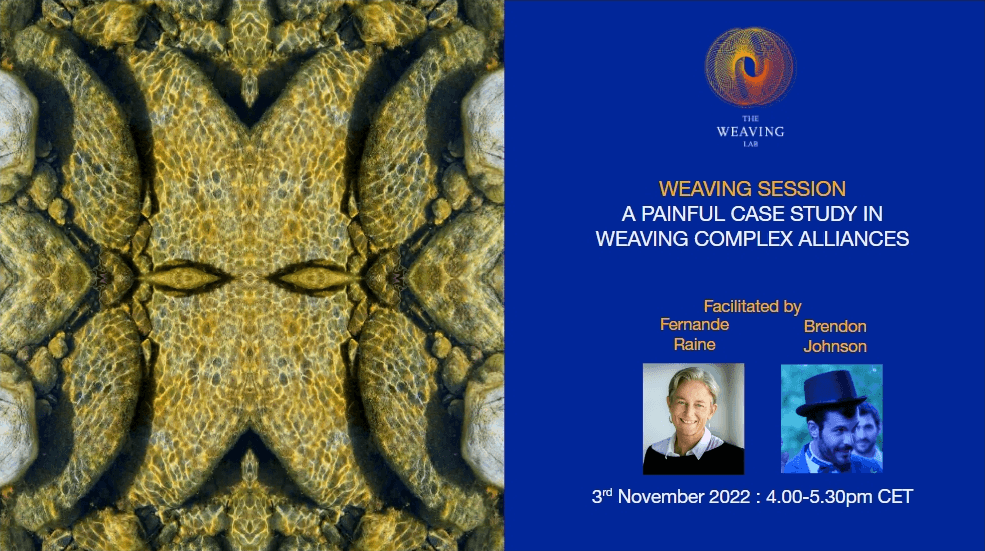
This was a “Peer Assist” workshop focussed on a real-world, “painful” case study: the effort to transform history and civics education in the U.S. through complex, ecosystem-level weaving.
The session looked into the personal and professional toll of trying to align massive institutions (like foundations, testing companies, and museums) with a new vision of holistic, learner- centered education.
Key Learnings
* The Transformation Gap: There is a massive disconnect in education between the exponential growth of private sector investment and the declining socio-economic mobility and mental health of students.
* Two Levels of Weaving: The team identified a need to weave at two levels simultaneously:
i. Domain-Specific: Connecting museums, teachers, and schools around history/civics.
ii. Ecosystem-Level: Reimagining the entire purpose and metrics of schooling (e.g., moving from test scores to well-being).
* The “Hamster Wheel” Problem: Museums and cultural organizations often operate in silos. Without collective impact or a “common language,” they remain “hamsters on individual wheels,” unable to achieve impact at scale.
* Institutional “Ego” and Doctrine: A major hurdle is institutional pride. Partners often insist their specific “7-point framework” is unique, even when it shares 90% of the same logic as others. The weaver’s job is to listen for these underlying alignments.
* The Cost of “Not Being Understood”: The team spent years “feeling like idiots” or being treated as “nuts” by foundations before the concept of ecosystem weaving finally gained traction and became “fresh and new” to funders.
Key Actions
* Practice “Untabling” the Table: Move away from “either/or” binary thinking. Instead of choosing between domain expertise and ecosystem change, visualize one sitting inside the other as a holistic system.
* Build Right-Hemisphere Muscles: Cultivate “holistic” and “relational” attention to counter the dominant culture of abstraction and fragmentation. Focus on experiences that help partners build their “listening muscles.”
* Find the “Coalition of the Willing”: Don’t try to change everyone at once. Focus on the partners who share your values and are ready to “play the game” of systemic change.
* Use Natural Metaphors: Use the image of a forest or mycelium to help partners see themselves as different “species” in a shared niche, rather than competing organizations.
* Lead with Questions, Not Doctrine: To avoid political and institutional pushback, don’t start with a new world-view or doctrine. Start with invitation and a willingness to be the “cog in the wheel” that creates trusted spaces.
—–
References & Tools Mentioned
Frameworks & Concepts:
- The Peer Assist Process: A knowledge-management technique for collaborative problem-solving.
- Educating for American Democracy (EAD): A roadmap for U.S. history and civics.
- Peter Senge, Kania & Kramer: Frameworks for systemic change and collective impact.
- Ian McGilchrist: The Master and His Emissary (Right vs. Left brain attention).
Organizations:
- The Carnegie Foundation & ETS: Partners in reimagining educational metrics.
- Jacobs Foundation & Lego Foundation: Funding and strategy partners.
- Ashoka: Referenced for its history of social entrepreneurship and “gut sense” vetting.
Knowledge base Categories: 1) Funding & Strategy 2) The Future of Weaving