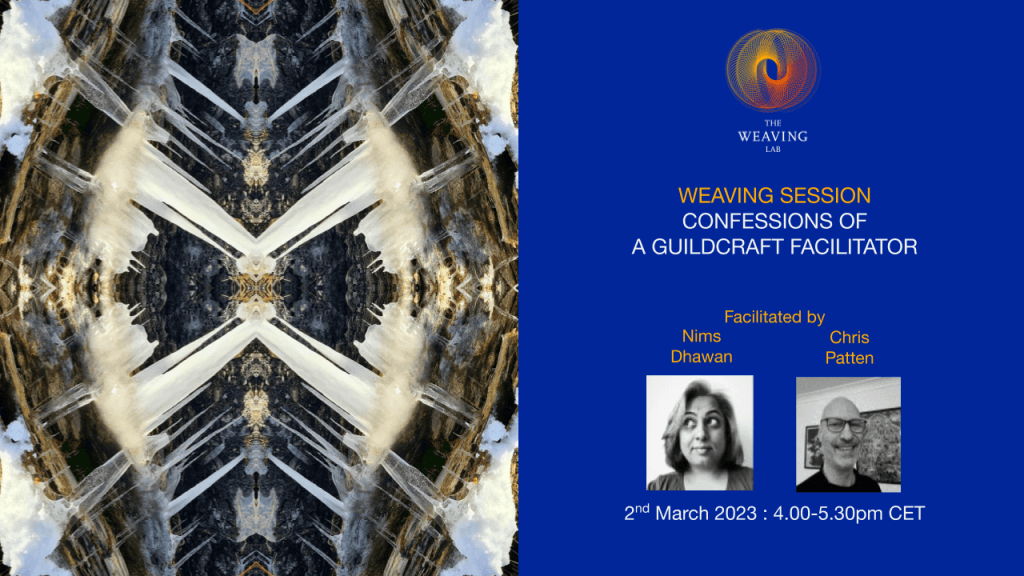
With Chris Patton and Nims Dhawan, 2 March 2023
Summary
This session explored corporate culture change, institutional power dynamics, and the psychological realities of facilitation. It looked at building grassroots networks (“guilds”) as sub-cultural toolsets that can bypass rigid corporate hierarchies, manage systemic corruption, and foster authentic communication.
Key Learning Points
1. The Concept of “Guildcraft” and Power Dynamics
- The Shadow Side of Systems: Institutional systems are rarely governed entirely by overt rules; they are frequently driven by power struggles, assumptions, hidden narratives, and subtle forms of cultural corruption.
- Guilds as Social Contracts: A guild functions as a “club within a club” or an alternative cultural network. By stepping into a guild, members accept a new social creed that overrides corporate hierarchy: “Leave all job titles, pay grades, and egos at the door”
- The Power of Swarming: Once deep alignment and trust are established within a guild, members can form a highly reactive, virtual squad that “swarms” onto problems, effectively shoring up underfunded innovations or neutralizing bureaucratic roadblocks
- The Jester Archetype: Playing the role of the jester or the “eccentric influencer” serves as a protective strategic tool. By intentionally sounding unthreatening or absurd, facilitators can leak disruptive truths and plant transformational seeds without being categorized as institutional threats by leadership.
2. The Traps of Group Leadership
- The Move-Ahead Trap: Natural organizers and “move-aheaders” frequently step up because they lack the patience to wait for a stagnant group to take action .The risk is that the leader ends up entirely owning the project while the rest of the group waits passively for them to make it happen.
- The Courage to Step Back: True sustainability requires catalytic leaders to intentionally step back, share authority, and actively encourage others to step up into the empty space.
Key Action Points
- Establish Clear Sanctuary Rules: When creating new communities of practice, explicitly speak a protective, non-hierarchical opening creed at the start of every single session to break rigid corporate filters.
- Map Systemic Overton Windows: Track your organization’s current baseline vocabulary. If the community understands lean principles, introduce flow; if they accept flow, guide them toward complexity modeling, gradually expanding what can be openly discussed.
- Anchor Alignment Through Purpose: Focus initial facilitation efforts on clarifying individual purposes, and then align those targets with a unified collective vision.
- Curate Imaginative and Playful Spaces: Incorporate light, simple, open-ended exercises into rigid corporate structures to rapidly shift group energy and unblock stuck thinking.
- Engage in Co-Creative Transition: Take note that The Weaving Lab’s founding organizers are intentionally stepping back to transition the community into its next phase ( p. 33). Members are urged to join the WhatsApp group to actively co-create this new learning format.
References
- Charmaz, K. (2014) / Constructivist Grounded Theory: Framework utilized within the lab to trace subjective narrative experiences and behavioral pattern insights.
- Greene, R. (1998): The 48 Laws of Power. Framework used by presenters to analyze, interpret, and unpack undercurrents of corporate influence and control.
- Heffernan, M. (2015): Super Chickens. TED presentation cited to challenge standard hyper-competitive models of performance and corporate execution.
- Laloux, F. (2014): Reinventing Organizations. Management theory utilized by facilitators to track structural evolution and decentralized human systems.
Knowledge Base Categories: 1) Decolonialisation, Equity & Inclusion, 2) Weaving Methods