With Curtis Ogden on February 5, 2026.
Curtis presented the science of energy movement across different scales and disciplines to explore the implications for long-term human thriving, sustainability, and justice. He began with some exercises to bring awareness of the energy in our own bodies so we could be mindful of our individual and collective energy flow systems and networks as we addressed the theory in concept. Here’s the session summary:
Core Concepts of Energy Systems Science
The science posits that everything—from human bodies and organizations to economies and ecosystems—functions as a flow network. Curtis emphasized that “stuckness” in any system can be addressed by aligning with natural flows rather than forcing unnatural, overly engineered, or oppressive structures. He went on to offer four essential pillars for supporting the regenerative capacity of systems:
The Four Pillars of Practice
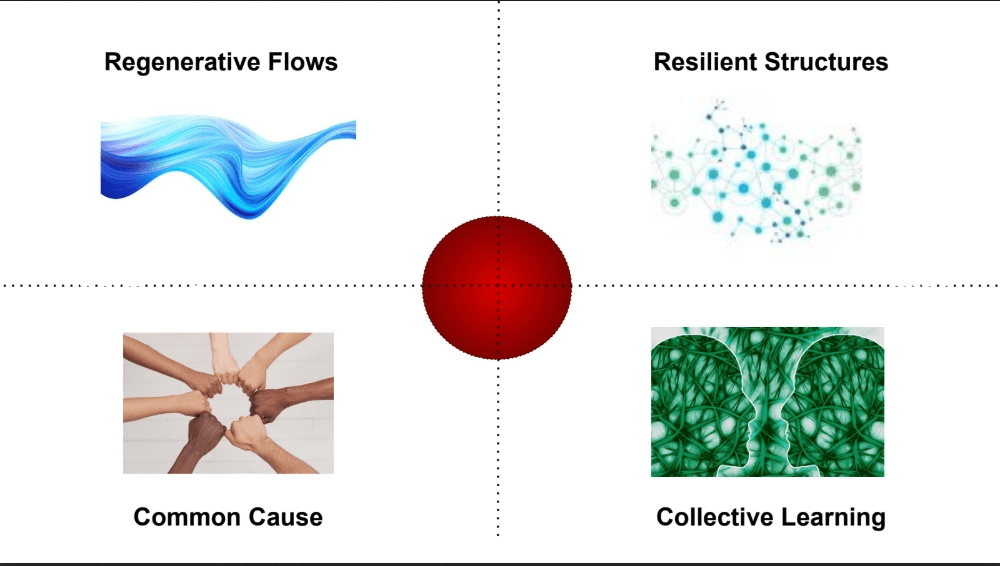
- Regenerative Circulation: Healthy systems require the robust movement of money, resources, information, and nutrients across all levels. When circulation is blocked or concentrated (e.g., through consolidation), parts of the system decay. Equity is central here, ensuring resources reach underserved populations.
- Balanced and Resilient Structures: Systems need “fractal” structures—a balance of many small, some medium, and a limited number of large entities. Ogden notes that modern economies often suffer from massive consolidation with too few middle-sized operators.
- Common Cause and Mutuality: Regenerative systems are held together by trust, reciprocity, fairness, and shared purpose. These are viewed not just as moral values but as functional, scientific requirements for system longevity.
- Collective Learning: Systems must be able to adapt and reorganize by pooling knowledge and sharing feedback. This involves systems thinking, peer-to-peer mentoring, and incorporating lived experiences from diverse communities.
Key Learning Points
- Energy as Everything: Recognize that even seemingly static physical structures are dynamic energy systems moving at various frequencies.
- The Power of “Allowing”: True flow often involves “allowing” energy to move rather than forcing it, similar to how fire finds its own way.
- Invisible Drivers: Understand that systemic health is often determined by invisible factors like mindsets, values, and even intergenerational trauma held in the body.
- Qualitative Over Quantitative: Focus on qualitative development (the quality of connections and health) rather than just quantitative growth.
Key Action Points:
- Assess System “Stuckness”: Identify where resources or information are blocked in your organization or community and work to restore circulation.
- Promote Fractal Balance: Support mid- and small-sized entities to create a more resilient, balanced structural ecosystem.
- Invest in Mutuality: Build structures that foster mutualism, such as shared ownership models and participatory community processes.
- Practice “Working Out Loud”: Foster collective learning by sharing rough-draft ideas and feedback early rather than waiting for polished products.
- Embodied Practice: Use physical movement (like Qigong) to release stagnant energy and maintain personal vitality to support wider systemic work.
During the session, Curtis referenced
- Dr. Sally J. Goerner: The New Science of Sustainability: Building a Foundation for Great Change
- Albert Einstein’s principle that everything is energy and that matching the frequency of a desired reality will inevitably bring that reality into being.
- Dr. Robin Wall Kimmerer: Braiding Sweetgrass.
- Dr. Ibrahim Karim’s idea that all life functions are based on energy interactions, which form the hidden dimension at the core of physiological functions.
- Denise Levertov: A poet
- Daniel Christian Wall: for the term “systemic salutagenesis,” (supporting the ongoing health-producing and regenerative potential of systems).
- Joel Glansberg: A permaculturalist and sustainable builder
- Vincent van Gogh: For painting the scientific dynamics of wind and air movement
- George Frederick Watts: Sculptor of “Physical Energy” which captures movement and dynamic energy within a stationary form.
Knowledge Bank Categories: 1) Regeneration & Universal Wellbing, 2) Weaving Methods