With Jeremy Lent 4 June 2026
Summary
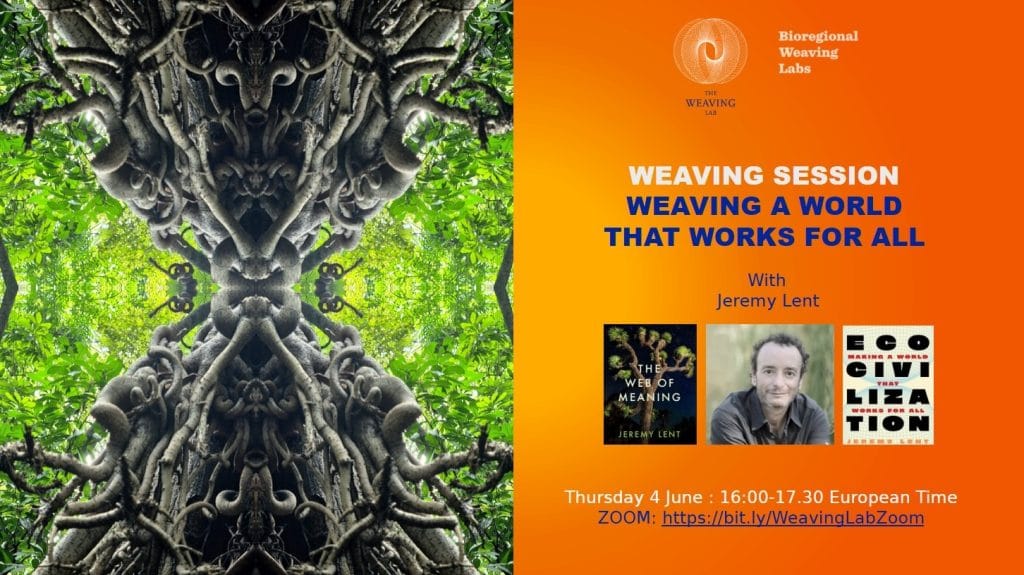
Jeremy Lent, author of The Patterning Instinct (2017), The Web of Meaning (2021) and Ecocivilization (2026) described the intellectual journey that has led him to his latest work and vision for an Eco-Civilization.
Key Learning Points
- Jeremy’s work, sparked by a personal crisis, synthesizes modern science and ancient wisdom to reveal humanity’s deep interconnectedness.
- This synthesis, detailed in The Web of Meaning, shows how modern science (e.g., complexity theory) and wisdom traditions (e.g., Taoism) converge on a non-reductionist view of reality.
- The concept of “eco-civilization” emerged as a vision for a world system based on these life-affirming principles, moving beyond the destructive modern worldview.
- Lent’s new book, Ecocivilization, counters the fatalism that makes imagining an alternative to capitalism seem harder than imagining the end of the world.
Key Topics
Jeremy’s Jouney
- A personal crisis (the collapse of his company and his wife’s illness ) prompted a search for meaning beyond the business world.
- This search involved a multi-year synthesis of intellectual research (history, science, philosophy) and spiritual practice (meditation, Taoism).
- The Patterning Instinct: Lent’s first book, a cultural history of humanity’s search for meaning, traced how different cultures’ worldviews shaped history and led to the current destructive modern worldview.
Synthesis — The Web of Meaning
- This book integrates science and wisdom to show that the perceived split between them is a false construction.
- It argues that modern systems sciences (e.g., complexity theory) and ancient wisdom traditions (e.g., Buddhism, Taoism) converge on the same core insight: deep interconnectedness.
- The book reframes life’s big questions (e.g., Who am I?) by showing how the dominant worldview’s answers are scientifically outdated and dangerous.
The Vision: Eco-Civilization
- The concept of “eco-civilization” emerged from the inquiry into what a world based on deep interconnectedness would look like.
- Rationale for the Term:
– “Civilization”: Signifies the necessary scope of change — a transformation of the entire system (economics, technology, agriculture), not just isolated reforms.
– “Ecological”: Provides the principles for this change, drawing from the resilience and richness of natural ecosystems.
- Goal of Ecocivilization: To counter the fatalism that makes imagining an alternative to capitalism seem harder than imagining the end of the world.

FURTHER ACTIONS
– Consider joining the Deep Transformation Network
– Consider involvement with the Ecocivilization Coalition
Knowledge Bank Categories: 1) Regeneration & Universal Wellbeing, 2) Inner Work