With Keith McCandless, 6 June 2024
Summary
This session looked at “Liberating Structures” as a facilitation framework designed to simplify complex network challenges. Moving intentionally at a rapid and “dynamically incomplete” pace, the session presented visual online tools, guiding participants through live exercises to demonstrate how structured anonymity and collaborative evaluation can reveal deeper group contexts, unpack hidden tensions, and shape healthier network patterns.
Key Learning Points
- Liberating Structures Origin: Developed over a ten-year period by Keith McCandless and Henri Lipmanowicz, the repertoire converts complex scientific ideas into practical interaction methods.
- The Power of Anonymity: Fast-paced, anonymous exercises are vital tools for clearing conversational logjams when groups are being too polite to voice underlying anxieties or blockages.
- Developmental vs. Standard Evaluation: Conventional evaluation targets flat outcomes (“did it work?”), whereas developmental evaluation maps immediate potential by measuring trust, clarity of context, and the generation of new options.
- Self-Similarity of Group Patterns: Individual reflective assessments frequently mirror wider collective realities, allowing facilitators to identify overarching structural patterns across multiple scales.
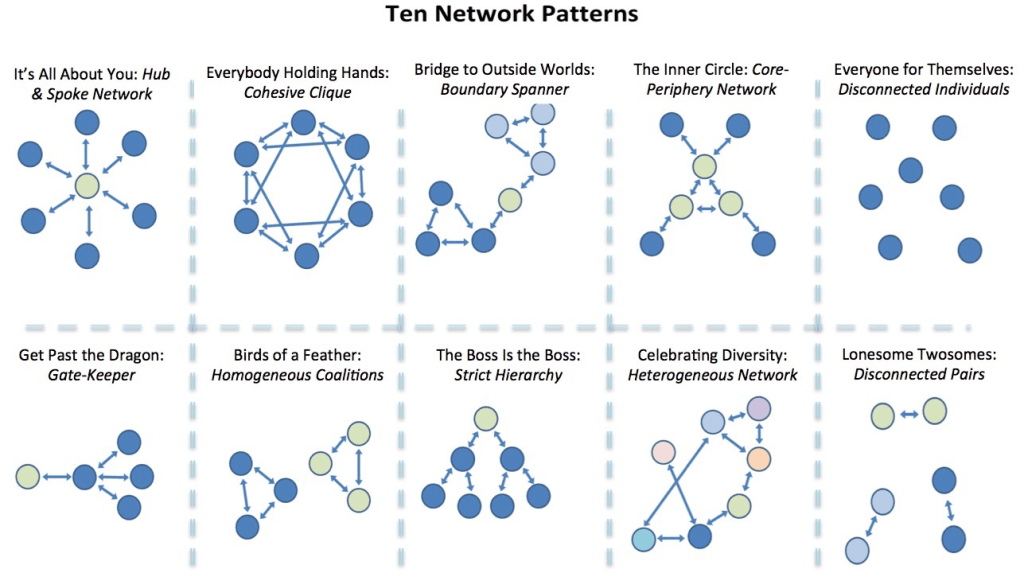
- Fluid Structural Shapes: A healthy organization does not need to maintain a single static format; it can naturally shift its shape (e.g., hierarchy for budgeting, hub-and-spoke for development, and heterogeneous for field operations) depending on the immediate function.
Key Action Points
- Run a Mad Tea Chatterfall: Drop open-ended sentences into a virtual chat, give participants 30 seconds to respond, and command a simultaneous press of the “Enter” key to generate an unfiltered surge of group insight.
- Utilize an Engagement Spidergram: Plot group or client experiences across eight distinct axes (Connection, Identity, Authorship, Discovery, Resolve, Map, Narrative) to evaluate where a collaborative space is thriving or stalling.
- Condense with the Triangle Tool: If time is restricted, skip the full spidergram and have members place a single point inside a triangle bounded by Connection, Context, and New Options to find the interaction’s center of gravity.
- Map Network Relationship Patterns: Assess your community against ten specific visual archetypes (e.g., Hub and Spoke, Core-Periphery, Cohesive Clique, Gatekeeper) to isolate differences between target goals and practical, on-the-ground realities.
- Lean Into Dynamic Incompleteness: Maintain momentum during complex gatherings by prioritizing rapid tool immersion over exhaustive perfectionism, trusting participants to unpack and master the nuances later.
References
- McCandless, K. & Lipmanowicz, H. The Surprising Power of Liberating Structures (referenced underlying core book and original 33-structure repertoire).
- McCandless, K. & White, N. Remastered Liberating Structures (referenced upcoming text detailing digital adaptations and newly developing frameworks).
Knowledge Base Categories: 1) Weaving Methods 2) Decolonisation, Equity & Inclusion