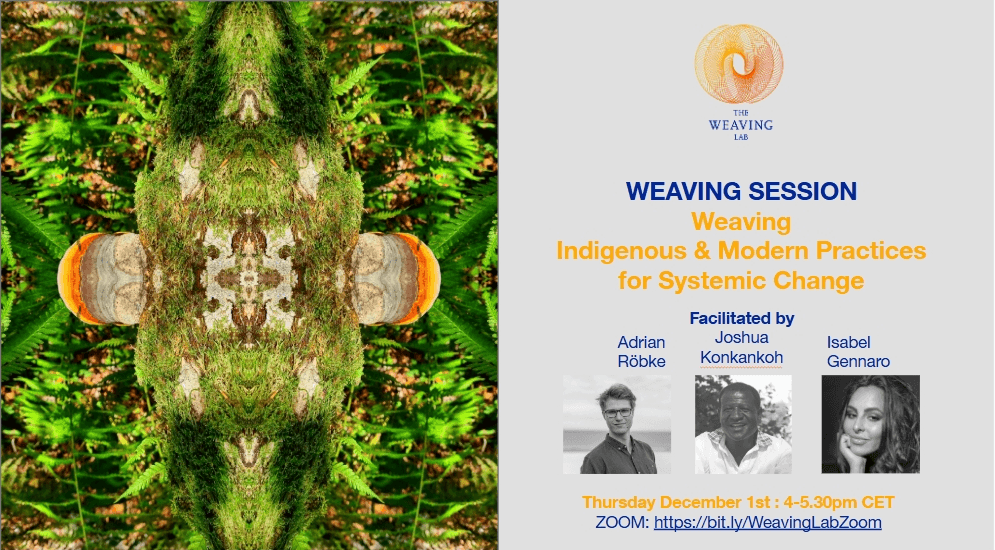
With Isabel Gennaro, Joshua Konkanko and Adrian Roebke, 1 Dec 2022
Summary
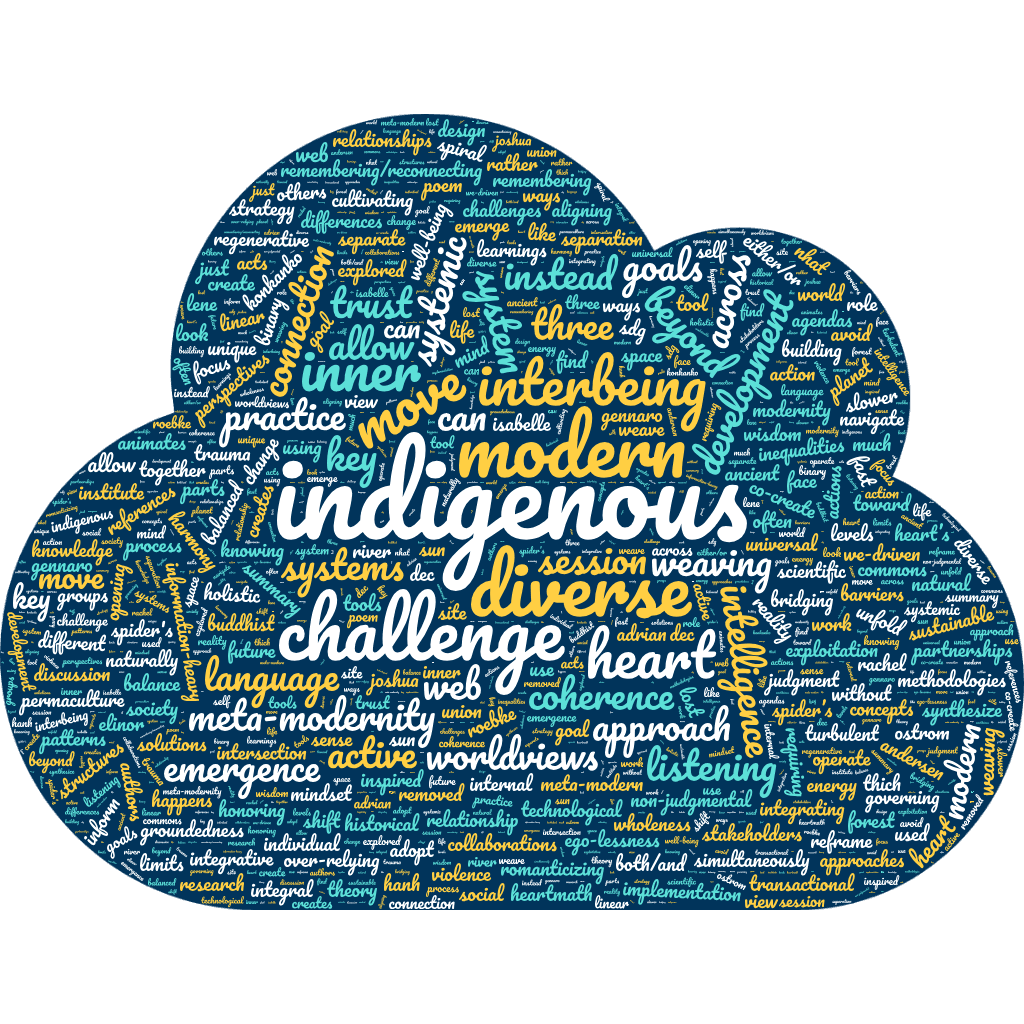
This session explored the intersection of ancient indigenous wisdom and modern systems- change tools. The goal was to move beyond the “either/or” binary and find a “meta-modern” space where these diverse ways of knowing can co-create a regenerative future for universal well-being.
Key Learnings
- Interbeing and Connection: Inspired by Buddhist and indigenous perspectives “interbeing” is the reality that we are not separate from the sun, the river, or each other.
- The Heart as a Systemic Tool: The heart has its own intelligence and “internal coherence.” While the mind often creates separation and judgment, the heart acts as a site for union and non-judgmental action.
- Bridging Inequalities: “the spider’s web” challenge to the “linear mindset” of modernity requiring the “I” to be removed to allow a holistic system to emerge.
- Meta-Modernity: an approach integrating diverse WorldViews (indigenous, scientific, technological) while honoring their unique differences to create a balanced view of life.
- Three Challenges of Weaving:
1. Relationship Challenge: Building trust in the face of historical trauma and exploitation.
2. Strategy Challenge: Aligning diverse stakeholders who have their own agendas.
3. Inner Development Challenge: Cultivating wholeness and groundedness in a turbulent, information-heavy world.
Key Actions
- Move from “Me” to “We”: Practice “ego-lessness” in collaborations. Focus on how individual parts can operate in harmony so that no energy is lost in the system.
- Inner Remembering/Reconnecting: Instead of just “inner work,” reframe it as remembering our connection to self, others, and the planet. This shift happens simultaneously across all three levels.
- Adopt Integrative Approaches: Look for “both/and” solutions. Avoid romanticizing the indigenous or over-relying on the modern; instead, weave them together to navigate systemic barriers without violence.
- Active Listening and Language: Use language that “animates” rather than limits. Practice active listening to move beyond transactional relationships toward a “we-driven” society.
- Trust the Emergence: Balance fast, modern implementation with a slower, indigenous sense of emergence. Allow the process to unfold naturally, much like a forest or a spider’s web.
—–
References
Authors & Concepts:
Thich Nhat Hanh: The opening poem on “Interbeing.”
Lene Rachel Andersen: Meta-modernity.
Spiral Theory: Integral approach to diverse WorldViews.
HeartMath Institute: Research on the heart’s intelligence and coherence.
Elinor Ostrom: Governing the Commons.
Methodologies:
Permaculture Design: Using natural systems to inform social structures.
Sustainable Development Goals (SDG 17): Partnerships for the goals.
Knowledge Weaving: A role used in the session to synthesize patterns across different discussion groups.
Knowledge Base Categories: 1) Decolonisation, Equity & Inclusion 2) The Future of Weaving